
Sofosbuvir 400 mg tablets, 28 tablets — generic (India) Hepcinat (Sofosbuvi) Delivery of medications from Europe within 4-5 days, compliance with storage conditions, payment upon receipt, order by phone number +380996042415 Viber, Whatsapp
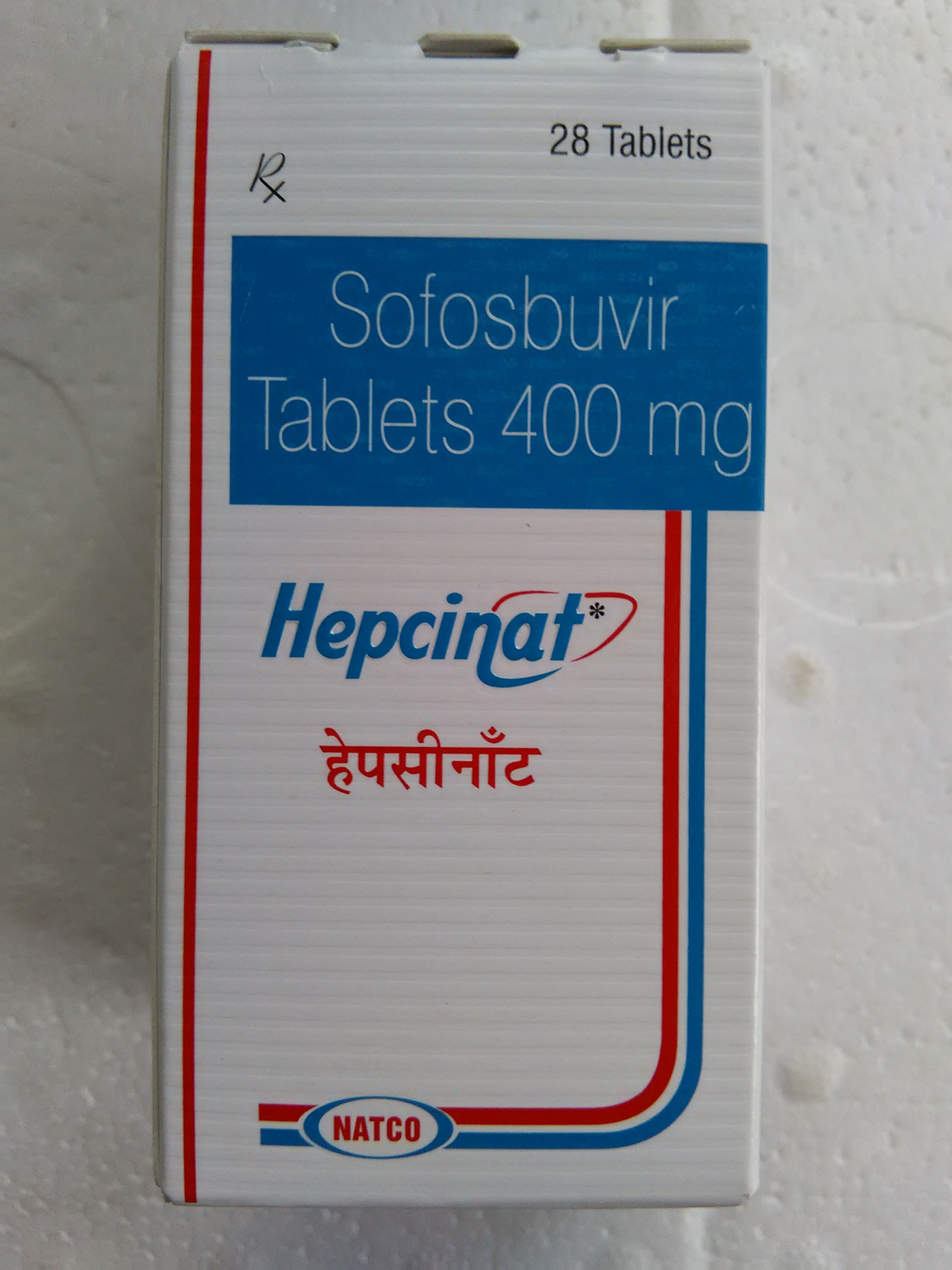
- EMC post
Delivery time
- 7-10 days
- Payment to Revolut card
Interchangeable drugs with the same active ingredient:
Grateziano
Sovaldi
Harvoni
Composition
Active ingredient: sofosbuvir;
1 film-coated tablet contains 400 mg sofosbuvir;
Excipients: Mannitol (E 421), microcrystalline cellulose, sodium croscarmellose, colloidal silicon dioxide, magnesium stearate
Tablet shell: polyvinyl alcohol, titanium dioxide, macrogol, talc.
Medicinal form
Tablets, coated Film-coated.
Main physicochemical properties:White film-coated capsule-shaped tablets, engraved with "GSI" on one side and "7977" on the other.
Pharmacological group
Direct-acting antiviral agents.
ATX code J05A X15.
Pharmacological properties
Pharmacological
action mechanism
Sofosbuvir is a pangenotypic inhibitor of the hepatitis C virus NS5B RNA polymerase, which is important for viral replication. Sofosbuvir is a nucleotide depot form that, after participating in intracellular metabolism, forms the pharmacologically active uridine analog triphosphate (GS-461203), which can be introduced into the RNA of the hepatitis C virus by NS5B polymerase, and acts as an agent that terminates the chain. In a biochemical assay, GS-461203 inhibited the polymerase activity of NS5B recombinants in hepatitis C virus genotypes 1b, 2a, 3a, and 4a with 50% inhibitory concentration (IC ) values ??in the range of 0.7 - 2.6 ?m. GS-461203 (the active metabolite of sofosbuvir) is not an inhibitor of human DNA or RNA polymerase, nor is it an inhibitor of mitochondrial RNA polymerase.
Antiviral action
In HCV replication assays, the effective concentration (EC 50 values ??of sufosbuvir against full-length REPLICON genotypes 1a, 1b, 2a, 3a, and 4a were 0.04, 0.11, 0.05, 0.05, and 0.04 ?M, respectively, and The EC50 of sofosbuvir against 1b-replicant REPLICON 1bs encoding NS5B genotype 2b, 5a, or 6a ranged from 0.014 to 0.015 ?M. Mean ± SD EC 50sofosbuvir against hybrid REPLICON coding sequences of NS5B from clinical strains was 0.068 ± 0.024 ?M for genotype 1a (n = 67), 0.11 ± 0.029 ?M for genotype 1b (n = 29), 0.035 ± 0.018 µm for genotype 2 (n = 15) and 0.085 ± 0.034 µm for genotype 3a (n = 106). In these assays, the in vitro antiviral activity of sofosbuvir against the less common genotypes 4, 5, and 6 was similar to that observed for genotypes 1, 2, and 3.
The presence of 40% human serum had no effect on the antiviral activity of sofosbuvir in HCV.
sustainability
Cell culture.HCV REPLICON with reduced susceptibility to sofosbuvir was selected in cell culture for many genotypes, including 1b, 2a, 2b, 3a, 4a, 5a, and 6a.Reduced susceptibility to sofosbuvir was associated with the primary NS5B substitution S282T in all genotypes of the REPLICON assay.Directed mutagenesis of the S282T substitution in REPLICON 8 genotypes provided a 2-18-fold reduction in susceptibility to sofosbuvir and an 89-99% reduction in viral replication capacity compared to the corresponding wild type. In biochemical assays, recombinant NS5B polymerase from genotypes 1b, 2a, 3a, and 4a, which expresses the S282T substitution, showed reduced susceptibility to GS-461203 compared with the corresponding wild types.
Clinical studies.In a pooled analysis with Of the 991 patients who received sofosbuvir in the phase 3 study, 226 patients were eligible for analysis of persistent virologic failure and early discontinuation; they must have HCV RNA > 1000 IU/mL. After initial NS5B sequences, 225 of 226 patients were available with deep sequencing data (1% analysis attrition) from 221 of these patients. The S282T substitution associated with sofosbuvir resistance was not detected in any of these patients by deep sequencing or population sequencing. The S282T substitution in NS5B was detected in one patient who received Sovaldi monotherapy in the phase 2 study. This patient had <1% HCV S282T at baseline and S282T (>99%) at week 4 post-treatment, resulting in a 13.5-fold change in EC 50sofosbuvir and reduced the possibility of viral replication. The S282T substitution reverted to wild-type over the next 8 weeks and was no longer detected by deep sequencing at 12 weeks post-treatment.
Two NS5B substitutions, L159F and V321A, were detected in post-treatment repeat samples across multiple genotypes of three patients infected with HCV in phase 3 clinical trials. No changes in phenotypical susceptibility to sofosbuvir or ribavirin were detected in isolated patients with these substitutions. Furthermore, the S282R and L320 substitutions were detected during treatment by deep sequencing in a pre-transplant patient with a partial response to treatment. The clinical significance of these findings is unknown.
The Impact of HCV Target Polymorphisms on Treatment Outcome
NS5B output sequences were obtained for 1,292 patients in the phase 3 study using population sequencing, and the S282T substitution was not detected in any patient with the original sequence. When analyzing the effect of baseline polymorphisms on the assessment result, no statistically significant association was found between the presence of the HCV NS5B variant at baseline and after treatment.
cross-resistance
HCV replicons expressing the S282T substitution associated with resistance to sofosbuvir were fully susceptible to other classes of HCV antiviral agents. Sofosbuvir retained activity against the NS5B substitutions L159F and L320F associated with resistance to other nucleoside inhibitors. Sofosbuvir was fully active against substitutions associated with resistance to other direct-acting antivirals with different mechanisms of action, such as non-nucleoside NS5B inhibitors, NS3 protease inhibitors, and NS5A inhibitors.
Pharmacokinetics
Sofosbuvir is a nucleotide depot form that is intensively involved in metabolism.The active metabolite is formed in hepatocytes and is not detected in plasma.The main (> 90%) metabolite GS-331007 is inactive. It is formed by sequential and parallel pathways leading to the formation of an active metabolite.
Absorption
The pharmacokinetic properties of sofosbuvir and the major circulating metabolite GS-331007 were evaluated in healthy adult subjects and patients with chronic hepatitis C. After administration, sofosbuvir was rapidly absorbed, and the highest plasma concentration was detected ~0.5-2 h post-dose, regardless of its level.The highest plasma concentration of GS-331007 was detected 2-4 h post-dose. Based on a population pharmacokinetic analysis in patients with HCV genotypes 1-6 infection (n = 986), the steady-state AUC 0-24 for sofosbuvir and GS-331007 was 1010 ng • h/mL and 7200 ng • h/mL, respectively. Among healthy patients (n = 284), the sofosbuvir and GS-331007 AUC 0-24were 57% higher and 39% lower, respectively, than in HCV-infected patients.
Food effects.Under dietary conditions, taking a single dose of sofosbuvir with a normal, high-fat meal slowed the rate of absorption of sofosbuvir.The extent of sofosbuvir absorption was increased by approximately 1.8-fold with little effect on maximum concentration. The activity of GS-331007 was not altered by high-fat meals.
Distribution
Sofosbuvir is not
