
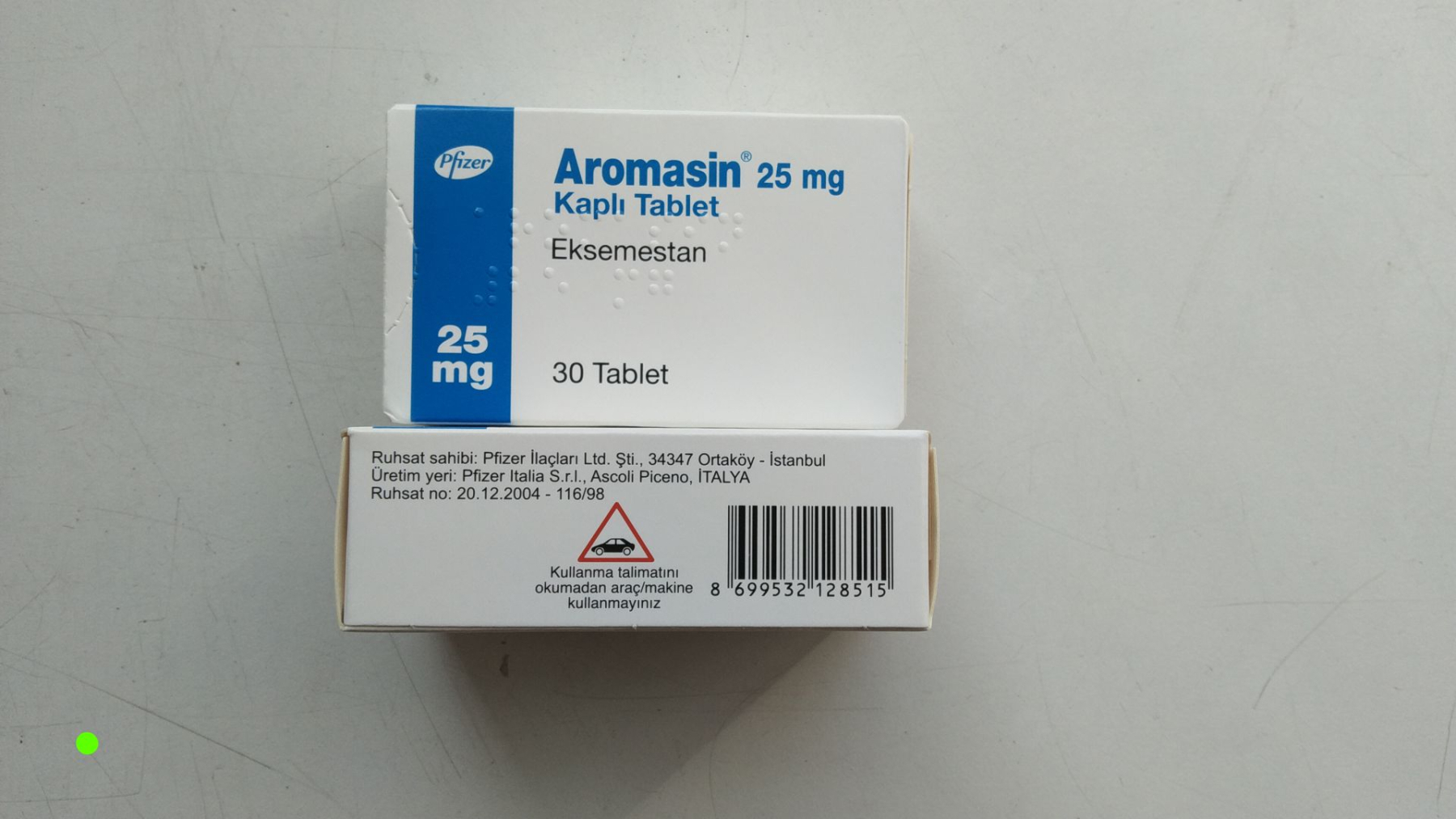
Aromasin (exemestane) 25 mg film-coated tablets, 30 tablets (Pfizer, Italy) — original Aromasin (exemestane) Targeted cancer therapy. Delivery of medications from Europe and elsewhere within 4-5 days, with storage conditions maintained, payment upon receipt. +380996042415
- EMC post
Delivery time
- 7-10 days
- Payment to Revolut card
Interchangeable drugs with the same active ingredient:
Aromasin
Aromastan
Exemesin
Exemestane - Vista
Exemestane Grindeks
Exemestane-Teva
Exomesin
Composition
Active ingredient: exemestane;
1 tablet contains 25 mg of exemestane
Excipients: mannitol (E 421), hypromellose, polysorbate 80, crospovidone, silicon dioxide, microcrystalline cellulose, sodium starch (type A), magnesium stearate, sugar coating (hypromellose, simethicone emulsion, Macrogol 6000, sucrose, magnesium carbonate, titanium dioxide (E 171), methyl parahydroxybenzoate (E 218), polyvinyl alcohol, cetyl esters of wax, talc, carnauba wax; ink: shellac, iron oxide (E 172), titanium oxide (E 171), ethyl alcohol, isobutyl alcohol.
Dosage form
Sugar-coated tablets.
Basic physicochemical properties: Round, biconvex, sugar-coated tablets, white to slightly gray in color, approximately 6 mm in diameter, imprinted with the numbers 7663 in black ink on one side.
Pharmacological group
Hormonal antagonists and similar agents. Enzyme inhibitors. ATC code L02B G06.
Pharmacological properties
Pharmacodynamics.
Exemestane is an irreversible steroidal aromatase inhibitor, similar in structure to the natural substance androstenedione. In postmenopausal women, estrogens are produced primarily through the conversion of androgens to estrogens by the aromatase enzyme in peripheral tissues. Blocking estrogen formation by inhibiting aromatase is an effective and selective treatment for hormone-dependent breast cancer in postmenopausal women. In postmenopausal women, exemestane significantly reduces serum estrogen concentrations, starting with a dose of 5 mg; maximum reduction (>90%) is achieved with doses of 10-25 mg. In postmenopausal patients diagnosed with breast cancer who received 25 mg daily, total aromatase levels were reduced by 98%.
Exemestane has no progestogenic or estrogenic activity. Slight androgenic activity, likely related to the 17-hydroderivative, was observed primarily at high doses. In studies of long-term daily use, exemestane did not affect the biosynthesis of hormones such as cortisol or aldosterone, whose levels were measured before or after the ACTH test, demonstrating selectivity for other enzymes involved in hormonal metabolism. Therefore, replacement therapy with glucocorticoids and mineralocorticoids is not necessary.
A slight increase in serum LH and FSH levels is observed even at low doses; however, this effect is expected for drugs of this pharmacological class; It likely develops through a feedback mechanism at the pituitary gland: decreased estrogen concentrations stimulate the secretion of gonadotropins by the pituitary gland (also in postmenopausal women).
Pharmacokinetics.
Absorption. After administration, exemestane is rapidly absorbed. The dose is absorbed from the gastrointestinal tract and is high. Absolute bioavailability has not been established, although distribution should be limited by the first-pass effect. With a single dose of 25 mg, the average plasma level reaches a maximum of 18 ng/mL after 2 hours. Coadministration with food increases its bioavailability by 40%.
Distribution. The volume of distribution of exemestane, uncorrected for oral bioavailability, is 20,000 L. Exemestane pharmacokinetics are linear, and the terminal half-life is 24 hours. Plasma protein binding is 90% and is concentration-independent. Exemestane and its metabolites bind to red blood cells. Exemestane does not accumulate in an unmetabolized manner after repeated dosing.
Metabolism and Excretion. Exemestane is metabolized by oxidation of the methylene group (6) via CYP3A4 and/or by reduction of the 17-keto group via aldo-keto reductases, followed by conjugation. Exemestane clearance is approximately 500 L/h, uncorrected for oral bioavailability.
These metabolites are either inactive or less active than the parent compound in terms of aromatase inhibition. The amount of unchanged drug excreted in urine accounts for 1% of the dose. Equal amounts (40%) of 14C-labeled exemestane were excreted in urine and feces over a period of one week.
Special Populations. Age. No significant correlation was observed between systemic exposure to Aromasin and patient age.
Patients with renal and hepatic impairment - see "Special Instructions for Use."
Indications
Adjuvant therapy in postmenopausal women with estrogen receptor-positive early-stage invasive breast cancer after 2-3 years of initial adjuvant tamoxifen therapy.
Treatment of advanced breast cancer in women with natural or induced postmenopausal status who have shown disease progression following anti-estrogen therapy. Efficacy has not been demonstrated in patients with negative estrogen receptor tests.
Contraindications
Aromasin is contraindicated in patients with hypersensitivity to the active ingredient or any other component of the drug. The drug is also contraindicated in premenopausal women, pregnant women, and breastfeeding women.
Interaction with other medicinal products and other interactions
In vitro studies have shown that this drug is metabolized by cytochrome P450 3A4 (CYP3A4) and aldo-keto reductases and does not inhibit any of the major CYP isoenzymes. A clinical pharmacokinetic study found that specific inhibition of CYP3A4 by ketoconazole did not affect the pharmacokinetics of exemestane.
Although pharmacokinetic effects were observed in pharmacokinetic interaction studies with rifampin, a potent CYP3A4 inhibitor, the drug's pharmacological activity (i.e., estrogen suppression) was not demonstrated, and no dose adjustment is required.
Aromasin should not be used with estrogen-containing medications, as they have a negative pharmacological effect when used concomitantly.
Special instructions
Prior to initiating treatment with aromatase inhibitors, 25-hydroxy vitamin D levels should be assessed, as severe deficiency is common in early-stage breast cancer. Women with vitamin D deficiency should receive vitamin D supplementation.
Given its mechanism of action, Aromasin should not be prescribed to women with premenopausal endocrine status. Therefore, in appropriate clinical cases, postmenopausal status should be established by assessing LH, FSH, and estradiol levels.
Considering that Aromasin is a drug that significantly reduces estrogen levels, a decrease in bone mineral density can be expected. Following adjuvant therapy with Aromasin, women with osteoporosis or at risk for osteoporosis should have their bone mineral density assessed by densitometry at the beginning of treatment. Patients using Aromasin should be monitored and, if necessary, treated for osteoporosis.
Aromasin tablets contain sucrose and should not be administered to patients with rare inborn errors of fructose metabolism, glucose-galactose malabsorption, or sucrase-isomaltase insufficiency.
Aromasin tablets contain methylparaben, which may cause allergic reactions (possibly delayed).
Patients with renal impairment.
In patients with severe renal impairment (CL with r
Patients with hepatic impairment.
In patients with moderate or severe liver impairment, exemestane exposure is 2-3 times higher than in healthy volunteers. No dose adjustment is required.
Use during pregnancy or lactation Breastfeeding.
Pregnancy. Animal studies have shown reproductive toxicity, so Aromasin is contraindicated in pregnant women.
Breastfeeding. Aromasin should also not be used by women who are breastfeeding.
Women in the perimenopausal period or with childbearing potential.
The physician should discuss the need for appropriate contraception with women who have the potential to become pregnant, as well as with women who are perimenopausal or have recently transitioned to the postmenopausal period, until their postmenopausal status is fully understood.
Possibility of affecting reaction time when driving or operating machinery.
Drowsiness, somnolence, asthenia, and dizziness have been reported during drug use. Therefore, patients should refrain from driving or operating other machinery. mechanisms.
Dosage and Administration
Adults and Elderly Patients
Aromasin is recommended to be taken 25 mg once daily, preferably after meals.
In patients with early-stage breast cancer, treatment with Aromasin should be continued until completion of five years of sequential adjuvant hormonal therapy (continuation of Aromasin therapy after tamoxifen) or until tumor recurrence.
In patients with advanced breast cancer, Aromasin treatment should be continued as long as tumor progression is evident.
No dose adjustment is required for patients with liver or kidney failure.
Children.
This drug is not recommended for use in children.
Overdose
Data on the use of Aromasin in single doses 600-800 mg indicate good tolerability at these doses. The dose of Aromasin that can lead to life-threatening symptoms has not been established. In animal studies, lethality was recorded after administration of a single dose equivalent to 2000 and 4000 times the recommended human dose in mg/m2, respectively. There are no specific antidotes for overdose; symptomatic treatment should be administered.
Adverse reactions
Aromasin was generally well tolerated in all studies at a dose of 25 mg/day; adverse events were usually mild to moderate in severity.
The rate of treatment interruptions due to adverse events was 7.4% in patients with early-stage breast cancer treated with Aromasin after initial adjuvant therapy with tamoxifen. The most common adverse events were hot flushes (22%), arthralgia (18%), and increased Fatigue (16%).
The rate of discontinuation due to adverse events was 2.8% in the overall population of patients with advanced breast cancer. The most common adverse events were hot flashes (14%) and nausea (12%).
Most adverse events can be explained by the normal pharmacological consequences of estrogen blocking (e.g., hot flashes).
Adverse reactions by various organs and systems of the body are listed below. Very common (? 1/10), common (? 1/100 to <1/10), uncommon (? 1/1,000 to <1/100), rare (? 1/10,000 to <1/1,000).
Metabolism and metabolism disorders: common - anorexia.
Psychiatric disorders: very Common - Depression, Insomnia.
Nervous system disorders: Very common - Headache, dizziness; Common - Carpal Tunnel Syndrome; Uncommon - Drowsiness.
Vascular disorders: Very common - Hot flashes.
Gastrointestinal disorders: Very common - Abdominal pain, nausea; Common - Vomiting, Diarrhea, Constipation, Dyspepsia.
Gastrointestinal disorders: Very common - Increased liver enzymes, Increased bilirubin levels in the blood, Increased alkaline phosphatase levels in the blood.
Skin and subcutaneous tissue disorders: Very common - Increased sweating; Common - Alopecia, rash.
Musculoskeletal disorders: Very common - Joint and muscle pain (including arthralgia and, to a lesser extent, pain in the extremities, back, osteoarthritis, arthritis, myalgia, joint stiffness) common - fractures, osteoporosis.
General disorders: very common - pain, fatigue; common - peripheral edema; uncommon - asthenia.
Blood and lymphatic system disorders: thrombocytopenia and leukopenia have been rarely reported in patients with advanced breast cancer. Episodes of decreased lymphocyte counts were observed in approximately 20% of patients taking Aromasin, particularly in patients with pre-existing lymphopenia; however, the average lymphocyte count did not change significantly over a relatively long period of time in these patients; no increase in the incidence of viral infections was observed. These effects were not observed in patients with early-stage breast cancer.
In a study of early-stage breast cancer, the incidence of ischemic cardiac complications in the exemestane and tamoxifen treatment groups was 4.5% and 4.2%, respectively. No significant difference was observed for any of the individual cardiovascular complications, including hypertension (9.9% vs. 8.4%), myocardial infarction (0.6% vs. 0.2%), and heart failure (1.1% vs. 0.7%). Vaginal hemorrhage (4% vs. 5.3%), early-stage cancer of other organs (3.6% vs. 5.3%), and thromboembolism (0.7% vs. 0.8%) also occurred.
Exemestane was associated with a higher incidence of hypercholesterolemia than tamoxifen (3.7% vs. 2.1%).
In the early-stage breast cancer study, gastric ulcer was observed at a slightly higher rate in the exemestane group than in the tamoxifen group (0.7% vs. <0.1%). Most patients with a history of gastric ulcer were receiving concomitant nonsteroidal anti-inflammatory drugs (NSAIDs) and/or had a history of ulcers.
Post-marketing experience
Immune system disorders: Uncommon - hypersensitivity.
Nervous system disorders: Common - paresthesia.
Digestive system disorders: Rare - hepatitis, cholestatic hepatitis.
Skin and subcutaneous tissue disorders: Common - urticaria, pruritus; Rare - acute generalized exanthematous pustulosis.
Shelf life
3 years.
Storage conditions
Store at a temperature not exceeding 30°C.
Keep out of reach of children. place.
- Trade Name:Aromasin
- Chemical Name:Exemestane
- Dosage:25 mg
- Quantity:30
- Form of Issue:Tablets
